
Homelab & Home Server
How to Access Your NAS Remotely, Safely (2026)
The safe ways to access your NAS from anywhere — Tailscale, a VPN, or vendor tools — and why you should never port-forward your NAS admin.
Quick answer: Use a private mesh VPN like Tailscale. It reaches your NAS from anywhere without opening a single port, works behind carrier-grade NAT, and takes about ten minutes. Do not port-forward the NAS admin panel — not on a strange port, not "temporarily". It is one of the most heavily scanned targets on the internet.
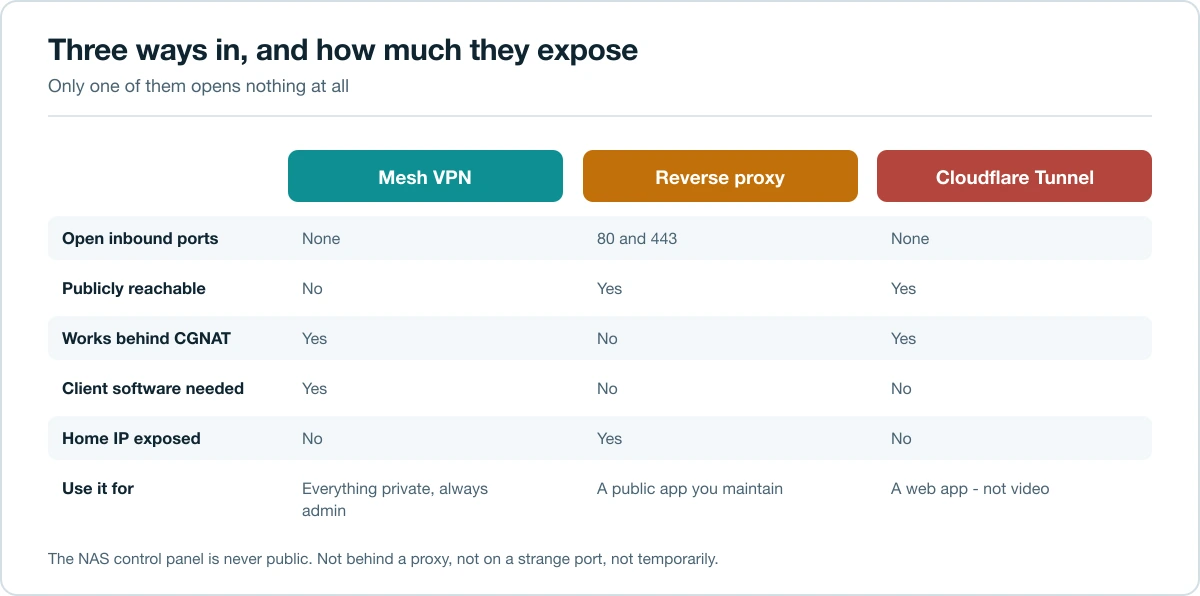
There are only three real ways to reach a NAS from outside your house, and they differ enormously in how much of your box the internet can see. The rest of this guide is about picking the right one and not accidentally choosing the worst.
Option 1 — Mesh VPN (the default answer)
Tailscale, and comparable WireGuard-based mesh networks, build an encrypted private network between devices you own. Each device authenticates against your identity provider and gets a stable private address. Connections go peer-to-peer where the network allows, falling back to encrypted relays when it does not.
Why this is the right default:
- Nothing is exposed. No inbound port, no public listener, nothing for a scanner to find.
- It works behind CGNAT, where port forwarding is simply impossible.
- No router configuration, no dynamic DNS, no certificates to renew.
- Full access — the admin panel, SMB shares, SSH, everything, exactly as if you were at home.
The limitation: every device you connect from needs the client installed. Phones, tablets and laptops are fine. A hotel lobby PC or a relative's smart TV is not.
Setup is covered in our Tailscale NAS guide. If you share access with family, restrict what each device can reach rather than handing out the whole network — see Tailscale ACLs for NAS.
Option 2 — Reverse proxy with HTTPS
If you need a normal https://something.yourdomain.com URL that works in any browser on any device, you need something publicly reachable. A reverse proxy is the controlled way to do that.
The shape: a domain you control, ports 80 and 443 forwarded to a proxy (Caddy, Nginx Proxy Manager, Traefik), automatic Let's Encrypt certificates, and hostname-based routing to individual services on the LAN.
What you are taking on: the proxy and everything behind it is now internet-facing. That means keeping it patched, strong authentication on every service, and ideally an authentication layer in front. See reverse proxy explained.
Expose individual applications, never the NAS control panel. A public Jellyfin or Nextcloud login page is a reasoned decision. A public DSM or QTS login page is the keys to everything.
Option 3 — Cloudflare Tunnel
An outbound-only connector on your network gives you a public hostname without forwarding any port, and hides your home IP address behind Cloudflare's edge.
The caveat worth knowing: Cloudflare's self-serve terms restrict using the CDN to serve a disproportionate amount of non-HTML content, with video streaming the standard example. That makes tunnels a poor fit for media servers specifically. Check the current terms yourself before building around it.
Good for a document system or a wiki. Not the tool for Jellyfin — see Cloudflare Tunnel vs Tailscale vs reverse proxy for the full comparison.
What not to do
Do not port-forward the admin panel. DSM, QTS, TrueNAS, Unraid — none of these belong on the public internet. Scanners sweep the entire port range continuously, so a non-standard port buys you nothing.
Do not enable DMZ. It forwards everything to one host. There is no home scenario where this is correct.
Do not forward SMB (445) or NFS. These protocols were designed for trusted local networks and are among the most attacked ports there are.
Do not leave vendor relay services enabled if you are not using them. They are convenient, but each one is another externally reachable path into the appliance. Turn off what you do not use.
Do not rely on UPnP. It lets applications open ports without telling you. Disable it on the router and audit what is already open — most people find at least one rule they cannot explain.
Hardening, whichever route you choose
- A named admin account with a long unique password, and the default
adminaccount disabled. - Multi-factor authentication on every administrator account.
- Automatic account lockout after failed login attempts.
- Keep the OS, packages and containers patched. Remote access does not make outdated software safe.
- Least privilege. The account you use remotely does not need write access to everything.
- Read the login logs occasionally. Unexpected sources are the earliest signal you will get.
These are the same controls that matter for protecting a NAS from ransomware, because remote access is how most of it arrives.
Choosing between them
| You want | Use |
|---|---|
| Personal access from your own devices | Mesh VPN |
| Admin access of any kind | Mesh VPN, always |
| A public app for non-technical people | Reverse proxy |
| A public web app without exposing your IP | Cloudflare Tunnel |
| Remote media streaming | Mesh VPN, or a reverse proxy |
Many people run a mesh VPN for everything private and one public path for the single service that genuinely needs it. That combination is a good place to end up.
FAQ
Is a VPN server on my router the same thing? Functionally similar and fully self-hosted, but it needs an open UDP port and manual key management, and it will not work behind CGNAT.
Is my NAS vendor's remote access service safe? It is convenient and generally reasonable for occasional admin, but it depends on the vendor's infrastructure and widens your exposure. A mesh VPN puts you in control of the path.
Can I access SMB shares over Tailscale? Yes — the share behaves as if you were on the LAN. Performance depends on your upload speed, so large transfers will be slow.
What if my ISP uses CGNAT? Port forwarding is impossible. A mesh VPN or an outbound tunnel are your options.
How do I know if something is already exposed? Check the router's port-forwarding and UPnP tables, and your NAS's own external-access settings. Delete anything you cannot justify.
Related guides
Last updated: August 2026.